

A Historic FDA Approval
New Sunscreen Active Ingredient for Use
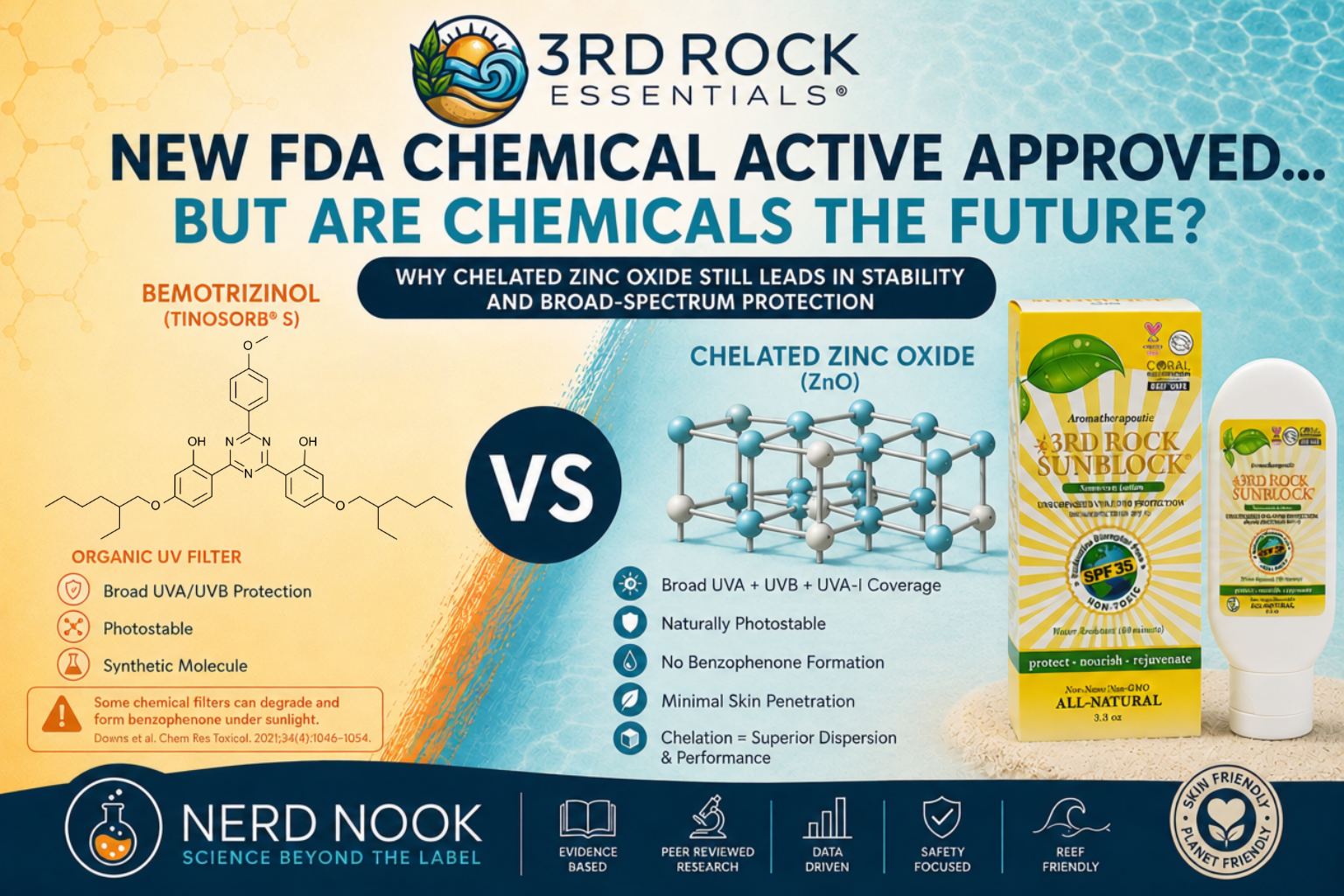
In June 2026, the FDA approved bemotrizinol (BEMT, Tinosorb® S), marking the first new sunscreen active added to the U.S. OTC monograph in more than 25 years. The compound has been used throughout Europe, Asia, and Australia since 1999 and provides broad-spectrum UVA and UVB absorption with exceptional photostability.
From a formulation standpoint, the new sunscreen active bemotrizinol represents a significant improvement over older organic UV filters such as:
- Oxybenzone
- Octinoxate
- Octisalate
- Homosalate
- Avobenzone
- Octocrylene
Unlike avobenzone, this new sunscreen active, bemotrizinol, does not rapidly photodegrade and can stabilize other UV filters.
But Is It Truly a New Approach?
Not really.
Bemotrizinol, the new sunscreen active recently approved by the FDA, belongs to the same chemical sunscreen philosophy that has dominated the market for decades:
Organic molecules absorb UV photons and convert that energy into heat.
The new sunscreen active is unquestionably a better chemical filter than many currently approved U.S. actives, but it remains a synthetic aromatic compound rather than a mineral particle.
The approval represents an evolution—not a revolution.
The Problem with Existing Chemical Filters
Several currently marketed organic filters have drawn attention because they can degrade or form unwanted byproducts under certain conditions.
Octocrylene and Benzophenone
A 2021 study by Downs et al. demonstrated that octocrylene formulations can slowly degrade and generate benzophenone, a compound classified by IARC as a possible human carcinogen. Benzophenone can then ultimately breakdown into benzene, an even more potent carcinogen.
Reference
Downs CA et al.
"Benzophenone Accumulates over Time from the Degradation of Octocrylene in Commercial Sunscreen Products." Chemical Research in Toxicology. 2021;34(4):1046–1054. DOI: 10.1021/acs.chemrestox.0c00461
Systemic Absorption of Chemical Filters
FDA maximal-use studies have demonstrated measurable blood concentrations above the agency's threshold for:
- Oxybenzone
- Avobenzone
- Octocrylene
- Octinoxate
- Homosalate
- Octisalate
(Mattern et al., JAMA, 2019; Mattern et al., JAMA, 2020.)
Importantly, the FDA has emphasized that detection in blood does not mean harm, only that additional toxicological data are needed.
Bemotrizinol, the new sunscreen active, appears to have substantially lower absorption than those ingredients.
Europe Has Used Bemotrizinol for More Than Twenty Years
Supporters often cite Europe's long history with Tinosorb S.
That history is real.
However, the rise in skin cancer incidence across Europe over recent decades demonstrates an important truth:
Better sunscreen chemistry alone has not solved the skin cancer problem.
According to European cancer registries and GLOBOCAN data, melanoma incidence has continued increasing throughout much of Europe during the period in which modern UV filters became widespread.
This increase reflects multiple factors:
- Aging populations
- Increased UV exposure habits
- Improved diagnosis
- Intermittent sunburn patterns
- Lifestyle changes
Therefore, increasing skin cancer incidence cannot be attributed to bemotrizinol directly, nor does its use appear to have reversed these trends.
Mineral Sunscreens Operate Differently
Mineral actives:
- Zinc oxide
- Titanium dioxide
work through a combination of scattering and absorption without relying on unstable organic molecules.
Zinc oxide is inherently photostable.
Unlike some chemical filters, zinc oxide:
- Does not produce benzophenone or benzene through degradation.
- Does not require stabilizers.
- Provides broad UVA and UVB coverage.
- Has minimal skin penetration.
- Has a long history of safe use.
Reference
Smijs TG, Pavel S. "Titanium dioxide and zinc oxide nanoparticles in sunscreens: focus on their safety and effectiveness." Nanotechnology, Science and Applications. 2011.
Why Chelated Zinc Oxide Matters
Not all zinc oxide sunscreens are created equally.
At 3rd Rock Essentials, we focused on chelated zinc oxide technology aided by natural food-grade ingredients and created 3rd Rock Sunblock Sunscreen Lotion.
Chelation and optimized dispersion provide several advantages:
Superior Particle Distribution
Uniform distribution reduces agglomeration and creates more consistent protection across the skin surface.
Enhanced Photostability
Because zinc oxide itself is already photostable, maintaining proper particle dispersion helps preserve performance throughout sun exposure.
Broad-Spectrum Coverage
Zinc oxide uniquely spans:
- UVB
- UVA-II
- UVA-I
making it one of the broadest-spectrum sunscreen actives available.
Minimal Systemic Absorption
Numerous studies have demonstrated that zinc oxide remains primarily on the skin surface.
Reference
Gulson B et al. "Small amounts of zinc from zinc oxide particles in sunscreens applied outdoors are absorbed through human skin." Toxicological Sciences. 2010.
Simplicity
A properly formulated zinc oxide sunscreen does not require:
- Avobenzone stabilizers
- Octocrylene boosters
- Multi-filter cocktails
- Complex degradation management
Why We Believe Chelated Zinc Oxide Represents the Gold Standard
At 3rd Rock Essentials, we believe sunscreen should prioritize:
Stability
No degradation concerns.
Broad Spectrum Protection
Coverage extending into UVA-I.
Simplicity
One highly effective active rather than numerous interacting molecules.
Minimal Absorption
Protection where it belongs—on the skin.
Long-Term Safety
Supported by decades of scientific evidence.
While the new sunscreen active, bemotrizinol, is unquestionably an improvement over many legacy chemical filters, it still represents refinement of the same organic-filter paradigm.
Chelated zinc oxide takes a fundamentally different approach.
And sometimes the most elegant solutions are the ones nature provided first.
References
- Downs CA et al. Chemical Research in Toxicology. 2021;34(4):1046-1054.
- Matta MK et al. JAMA. 2019;321(21):2082-2091.
- Matta MK et al. JAMA. 2020;323(3):256-267.
- Smijs TG, Pavel S. Nanotechnology, Science and Applications. 2011.
- Gulson B et al. Toxicological Sciences. 2010.
- FDA. "FDA Expands Sunscreen Options for the First Time in 20 Years." June 9, 2026.
- Environmental Working Group review of bemotrizinol.


