

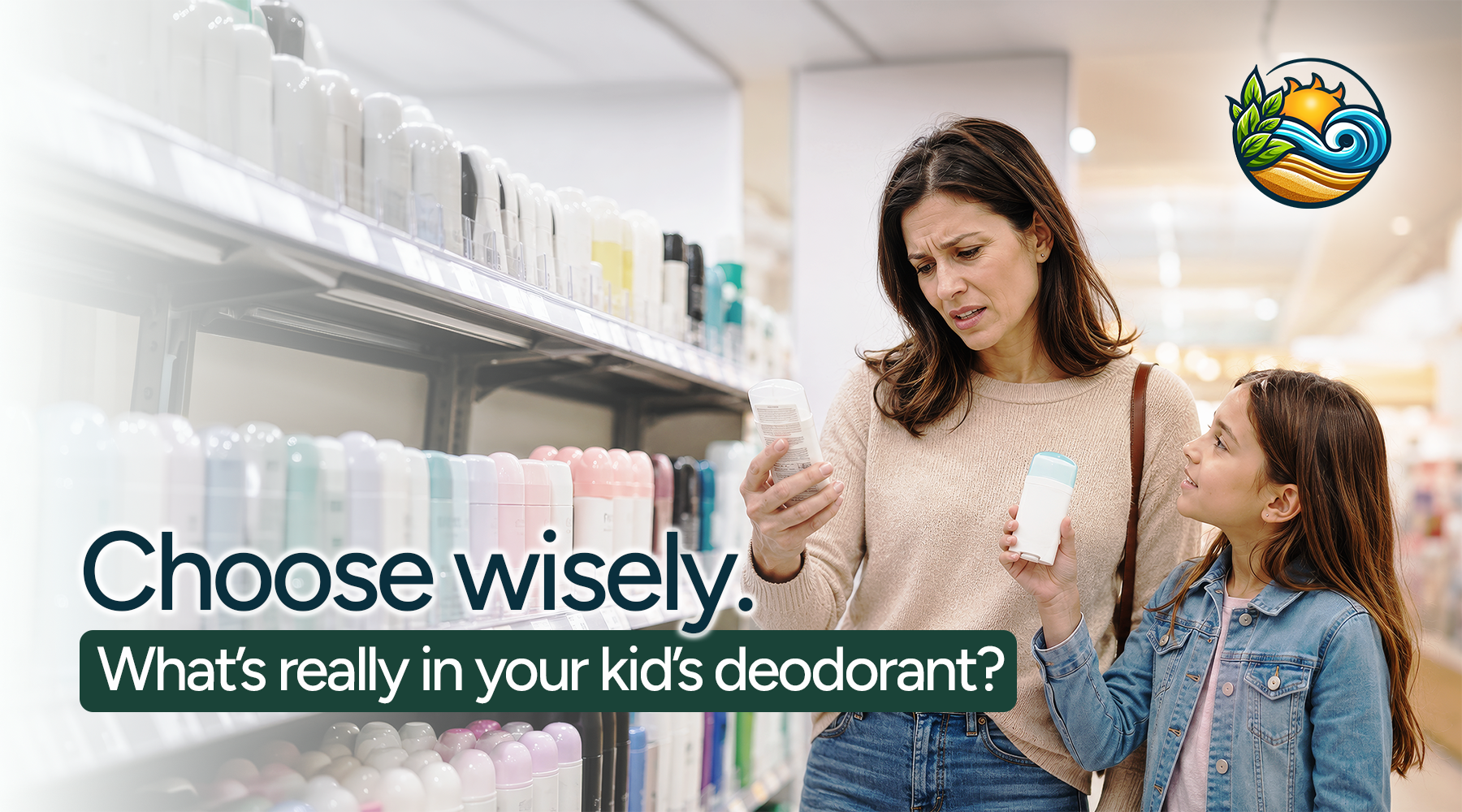
If you have started reading labels more closely since becoming a parent, you have probably noticed how many personal care products list ingredients you cannot easily explain. Deodorant is often one of them. That is what leads a lot of families to start looking for an aluminum-free deodorant, especially once kids get old enough to need one of their own.
Here is what the research actually says, and what to think about as you compare options.
Deodorant vs. antiperspirant: they are not the same thing
Antiperspirants contain aluminum salts, like aluminum chlorohydrate, that form a temporary plug in sweat ducts to reduce how much you sweat. Deodorants work differently. They do not stop sweat. Instead, they focus on managing the odor that shows up when sweat mixes with bacteria on the skin. Aluminum-free deodorants fall into this second category by design.
What the science says about aluminum
A number of large reviews, including a 2014 toxicology review often cited by dermatologists, along with statements from the National Cancer Institute and the American Cancer Society, have not found convincing evidence that aluminum in antiperspirants raises breast cancer risk. A 2023 study looking at how aluminum moves through skin found that these compounds do not reach the sweat glands underneath, which supports the idea that very little gets absorbed into the body from normal use. Kidney health organizations note that typical use does not deliver enough aluminum through the skin to cause harm, though people with significantly reduced kidney function are often advised to watch their overall aluminum exposure.
None of this means aluminum-free products are unnecessary. It just means the choice tends to come down to personal preference, skin sensitivity, or wanting a simpler ingredient list, rather than an established health risk.
Why some people still choose aluminum-free
For families managing skin sensitivity or just aiming for a simpler routine, aluminum-free deodorants can be a good fit. Common ingredients in this category include:
- Baking soda or magnesium hydroxide, used to neutralize the acids that cause odor
- Arrowroot or cornstarch, used to absorb moisture
- Plant oils and butters like coconut oil or shea butter, along with essential oils, used to condition skin
One thing worth knowing: baking soda-based formulas can be effective at controlling odor, but they are also linked to a higher rate of skin irritation in some people, since they can shift the skin's natural pH. That is one reason lower-pH or alternative-base formulas appeal to people with more reactive skin, including kids.


Choose your option

Back to School


All Natural Nutrasporin Ointment
Nutrasporin® - All Natural First Aid Ointment 100ppm Silver Gel
Choose your option


Silver Infusion 150 PPM Chelated Silver Oxide Supplement - 2 oz. Spray
Choose your option
Choose your option


ODORBlock Breath Freshener Spray
Choose your option
Shop the Back to School sale — 25% off with code BACKTOSCHOOL25
How we think about it at 3rd Rock
Our approach across the board is simple. If an ingredient is not safe to ingest, we do not think it belongs on skin. That is the same standard we bring to our body deodorant, which skips aluminum and other synthetic additives in favor of a more minimal, skin-safe formula.
We apply that same thinking to breath and body odor together. Our ODORBlock breath freshener spray is built around the same food-grade philosophy, giving families a way to address daily freshness without guessing at an ingredient list.
Both products are formulated to be vegan, cruelty-free, and gluten-free, reflecting our commitment to simple, skin-safe ingredients.
FAQ
Is aluminum-free deodorant as effective as regular antiperspirant? Aluminum-free deodorant works differently. It does not block sweat ducts the way antiperspirants do, so it will not reduce how much you sweat. Instead, it targets the odor caused by bacteria on the skin. Whether that feels "as effective" depends on what you are trying to manage, sweat or smell.
Is aluminum-free deodorant safer for kids? Current research has not found convincing evidence that aluminum in antiperspirants causes harm from typical use, including in kids. Aluminum-free options are more about ingredient preference and minimizing exposure to synthetic additives than about avoiding a known risk.
What ingredients should I look for in a natural deodorant? Look for odor-neutralizing ingredients like magnesium hydroxide, moisture absorbers like arrowroot or cornstarch, and skin-conditioning oils like shea butter or coconut oil. If your skin is sensitive, a lower-pH formula may be more comfortable than a baking soda-heavy one.
If you are looking to simplify your family's daily routine, our body deodorant is a straightforward place to start.


