

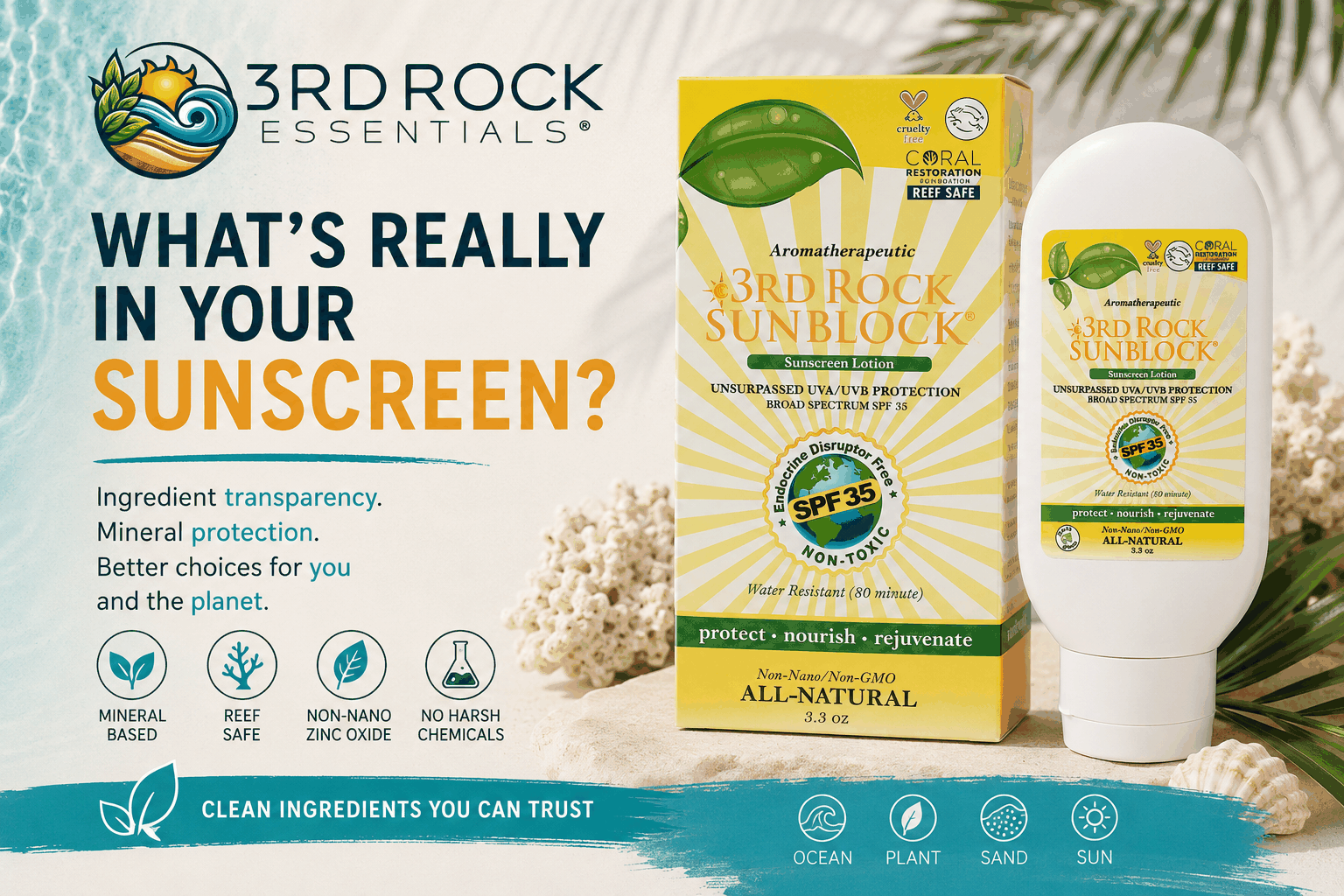
What's Really in Your Sunscreen?
Most people apply sunscreen every day without ever turning the bottle over to read the ingredient list. Many of the ingredients you could not recognize or pronounce if you did read the label. We trust the SPF number on the front label and assume we’re protected. But what’s really inside many sunscreens may surprise you.
The truth is, not all sunscreens are created equally. Some formulas rely on synthetic chemical filters and additives that many consumers intentionally try to avoid, while others use simpler mineral-based ingredients designed to sit on the skin’s surface and physically reflect UV rays. Understanding the difference can help you make more informed choices for your skin, your family, and even the environment.
Traditional “chemical” sunscreens often contain active ingredients such as oxybenzone, octinoxate, homosalate, and octisalate. These ingredients work by absorbing UV radiation and converting it into heat. While these ingredients are approved for use in many sunscreens, they have become the subject of growing consumer concern and scientific discussion regarding skin sensitivity, environmental impact, and long-term exposure.
Mineral sunscreens work differently. Instead of absorbing UV rays, ingredients like zinc oxide create a physical barrier that reflects and scatters sunlight away from the skin. Zinc oxide is widely recognized for providing broad-spectrum UVA and UVB protection and is commonly recommended for sensitive skin because it is generally less irritating than many chemical filters.
But here’s where things get tricky: many sunscreens marketed as “mineral” or “natural” still contain hidden synthetic UV boosters or chemical filter substitutes. Consumer discussions and ingredient reviews online have pointed out that some “all mineral” sunscreens include ingredients like butyloctyl salicylate, which can function similarly to traditional chemical sunscreen agents while still allowing brands to market their formulas as mineral-based.
That’s why reading the full ingredient list matters.
You need to know what's really in your sunscreen. Yes, it is super important to know what's really in your sunscreen protection.
A cleaner sunscreen formula should be transparent about every ingredient used — not just the active ones. Beyond UV filters, many conventional sunscreens contain preservatives, synthetic fragrances, parabens, petroleum derivatives, silicones, and stabilizers that may not align with a more natural skincare philosophy. Some people with sensitive or reactive skin report irritation, redness, stinging, or breakouts from heavily synthetic sunscreen formulas.
Another important consideration is particle size. You may have seen the terms “nano” and “non-nano” on sunscreen labels. Nano-sized particles are extremely small mineral particles engineered to reduce the white appearance often associated with zinc oxide sunscreens. Some consumers prefer non-nano zinc oxide because the larger particles are designed to remain on the skin’s surface rather than penetrate it. According to 3rd Rock Essentials, the zinc oxide used in their sunscreen begins at 200nm or larger and is further processed to create even larger particles.
Environmental concerns are also influencing sunscreen choices. Certain chemical sunscreen ingredients have been associated with coral reef damage, leading some coastal regions to restrict or discourage their use. What's really in your sunscreen is the cause. As a result, many consumers are shifting toward reef-safe mineral sunscreens that avoid ingredients linked to marine ecosystem disruption.
At 3rd Rock Essentials, the focus has always been on ingredient transparency and mineral-based sun protection. You know what's really in your sunscreen. Their sunscreen formulas use zinc oxide as the sole active ingredient and avoid synthetic fragrances, parabens, phthalates, and oxybenzone. 3rd Rock Essentials also emphasizes food-grade and earth-derived ingredients wherever possible.
Some of the ingredients found in 3rd Rock Sunblock® SPF 35 include:
- Zinc oxide for broad-spectrum UV protection
- Jojoba oil and olive oil to help moisturize skin
- Aloe vera for soothing support
- Vitamin E and Vitamin C antioxidants
- Raw beeswax with propolis for water resistance and antioxidant properties
- Patented chelated zinc oxide for unsurpassed protection
Of course, no sunscreen works properly if it isn’t applied correctly. Dermatologists and skincare experts consistently recommend using sunscreen daily, applying enough product to cover exposed skin, and reapplying during prolonged sun exposure or water activity. Even the cleanest sunscreen is only effective when used consistently.
At the end of the day, sunscreen should do more than simply provide an SPF number. It should align with your personal standards for ingredient safety, skin compatibility, and environmental responsibility. Taking a few extra seconds to read the label can help you better understand what's really in your sunscreen and what you’re putting on your skin every single day.
Because when it comes to sunscreen, what’s inside the bottle matters just as much as the protection it promises on the outside. You should always be aware of what's really in your sunscreen! Bad ingredients put you at risk of skin damage, DNA damage, and worse. 3rd Rock Sunblock promises real, recognizable ingredients. Ingredients you can trust from a company that cares.


